


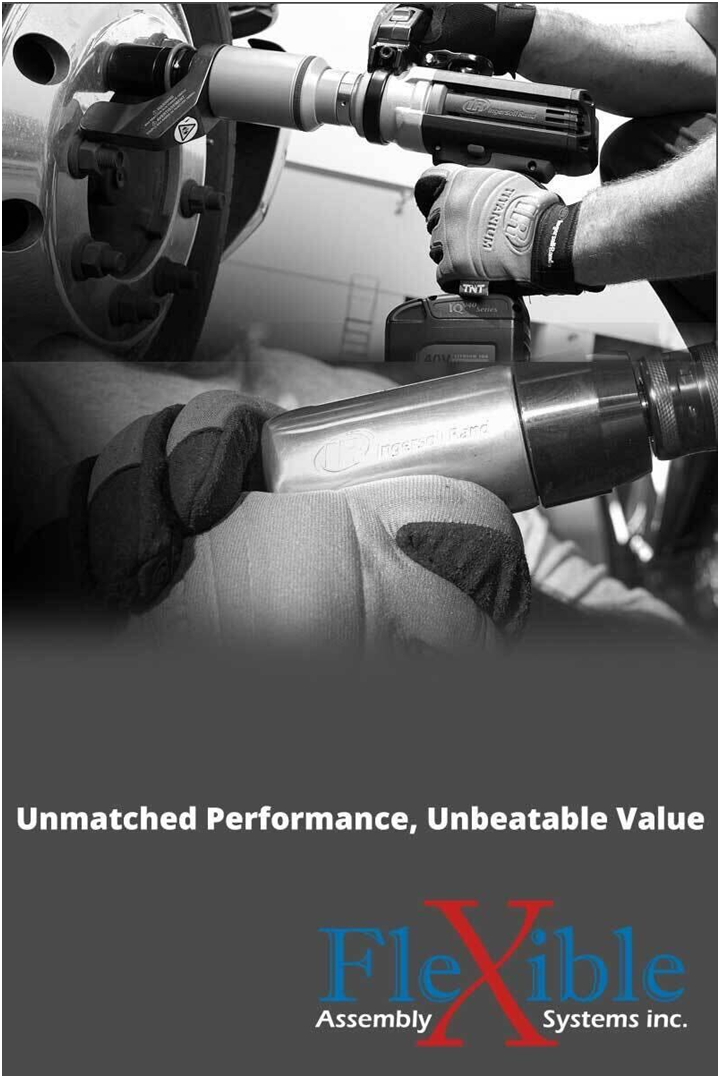
Torque-intensive joints—wheel ends, chassis joints, structural brackets, large covers, and heavy equipment flanges—tend to fail in expensive ways when torque control is treated as “good enough.” In production, impact wrenches are often selected for speed and access, but their pulse-based tightening makes the actual output torque harder to predict than with controlled-shutoff nutrunners. That gap matters during audits.
Consistent torque audits protect against three standard failure modes:
- Under-torque can lead to clamp loss, joint separation, leakage, and fatigue failure.
- Over-torque causes yield, thread damage, embedment, gasket extrusion, and rework.
- High scatter, with the average torque acceptable, but the tails of the distribution create outliers.
Engineers and quality teams typically face a decision set: when impacts are acceptable, when a controlled tool is required, what verification method is realistic on the plant floor, and how to document results with traceability and repeatable technique.
Impact wrench fundamentals for torque-intensive joints
An impact wrench delivers torque in pulses through a hammer-anvil mechanism. The joint sees a series of short torque spikes rather than a smooth ramp. For torque-intensive applications, key implications are:
- Torque is not directly controlled. Many impacts are “torque-limited” only by air pressure, battery capability, tool setting, and operator trigger time.
- Joint sensitivity is high. Complex joints (high stiffness) tend to reach clamp quickly with less rotation; soft joints (gaskets, stack-ups, coatings) absorb energy and increase scatter.
- Reaction management differs. Impacts reduce the continuous reaction force compared to steady torque tools, which improves ergonomics, but the pulses still cause vibration and noise concerns.
Cordless impact wrenches exhibit variability due to battery state of charge, temperature, and pack age. Modern cordless tools can be consistent when tightly managed, but the process must assume drift unless verified.
Cordless vs pneumatic impacts in production
Cordless impacts
Cordless tools improve mobility and reduce hose management. They fit well in areas with frequent access changes or where utility drops are limited. Control considerations include:
- Battery management (charge windows, pack life tracking, cold-condition performance)
- Tool firmware/settings control to prevent unauthorized mode changes
- Higher risk of torque variation as packs age or are swapped without controls
Pneumatic impacts
Air tools can be stable when the air system is controlled, but many lines do not control it tightly enough. Key drivers of scatter:
- Supply pressure variation at the point of use under load
- Water/oil contamination affecting motor performance
- Hose length and coupler restrictions are causing a pressure drop during impact events
If impacts are used for final tightening on a critical joint, the plant needs a defined verification plan that accounts for these variables rather than assuming the nameplate torque rating reflects real output.
When an impact wrench is the right tool
Impact wrenches are appropriate when the process tolerates torque variation or when they are used in a controlled role, such as:
- Rundown to snug before final tightening with a controlled tool
- Non-critical joints where clamp load is not safety- or performance-critical
- Serviceable joints where re-torque is part of routine maintenance
- High-access constraints where a reaction arm tool cannot be packaged, and an engineered verification method is in place
They are a poor fit for safety-critical or highly regulated joints unless torque is verified and documented in a manner that aligns with clamp requirements.
Torque verification with testers and torque screwdrivers
Torque testers for impact wrenches
A torque tester (torque analyzer) with the appropriate transducer and joint simulation is the primary audit tool for impact testing. Practical points that affect accuracy and repeatability:
- Use a joint simulator or rundown adapter. Free-spinning into a transducer does not represent a real joint. Simulator stiffness should match the application as closely as practical.
- Capture peak and/or pulse torque properly. Impacts can produce very short peaks. The analyzer must have sampling suitable for pulse tools; otherwise, readings can be misleading.
- Control the method. Define trigger time, tool angle, socket condition, and seating approach. Operator technique can dominate results if not standardized.
- Document the setup. Record tool ID, battery ID, or air pressure at point-of-use, simulator type, socket, and tool setting. Without this, audits are complex to trend.
Limitations remain: a tester reading is not the same as the clamp load on the vehicle or assembly. Use it to detect drift, compare tools, and enforce limits—not as proof that every joint achieved a specific clamp load unless the correlation has been validated.
Torque screwdrivers in mixed-torque environments
Torque screwdrivers are not used for torque-intensive joints, but they are commonly found on the same lines as electronics, trim, covers, and small fasteners. They matter in audit programs because they often set the “culture” of torque control:
- Mechanical clutch drivers are fast but can be affected by push force, angle, and the operator’s response after clutch slip.
- Electronic torque screwdrivers support data capture and can improve traceability, but they require disciplined calibration and bit/socket management.
Quality teams often audit both ends of the torque spectrum. A weak low-torque program usually signals weak controls elsewhere.
Audit workflow for impact tools
Production-friendly verification steps
- Verify the correct socket and extension configuration; replace worn sockets.
- Stabilize inputs: battery at a defined charge window or air pressure measured at the point of use under load.
- Run a defined number of tightenings into the joint simulator using a standardized trigger method.
- Record peak/strategic values (per tool type) and compare to control limits.
- If results drift, quarantine the tool, check settings, and re-test after corrective action.
Calibration, traceability, and documentation
- Calibration intervals should be based on risk: critical joints, high usage, harsh environments, or a history of high drift require shorter intervals.
- Maintain traceability: tool ID, serial number, calibration certificate, firmware revision (if applicable), battery pack IDs, and analyzer calibration status.
- Data capture should be appropriate to the risk. For impact, capturing periodic audit results may be more realistic than logging every fastening event.
Ergonomics, productivity, and long-term reliability
Impacts can reduce reaction torque and accelerate large fasteners, but they introduce noise and vibration exposure, and increase rework risk if torque scatter drives downstream checks. Cordless tools minimize trip hazards and hose fatigue, yet batteries are a reliability concern due to their own lifecycle and controls. From a maintenance standpoint, impacts need routine inspection of hammer mechanisms, anvils, and drive squares; wear changes output and repeatability.
Why Choose Flexible Assembly Systems?
Flexible Assembly Systems supports torque-intensive processes, with an emphasis on measurement integrity and auditability. That includes selecting torque analyzers suited to pulse tools, defining joint simulation approaches that reflect real assemblies, and establishing calibration and traceability practices aligned to regulated environments. Teams also benefit from application experience across mixed-torque stations—where impact wrenches, controlled nutrunners, and torque screwdrivers coexist—and from guidance on operator method control, documentation detail, and failure-mode-based audit frequency.
Conclusion
Impact wrenches, including cordless models, can be effective for torque-intensive tasks when their inherent variability is treated as a process characteristic to control, not a nuisance to ignore. Clear rules for where impacts are allowed, standardized verification with appropriate torque testers, and disciplined calibration and documentation practices are what keep speed from becoming a torque risk.
READ MORE: selftimes
