


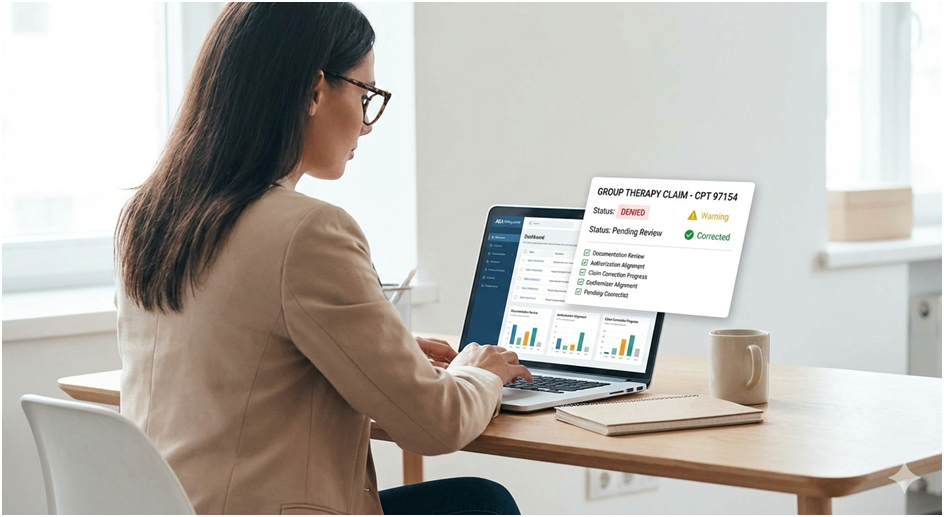
CPT code 97154 is one of the most misunderstood codes in ABA billing. It represents group adaptive behavior treatment, but many claims are denied, not because the service was wrong, but because the billing or documentation did not clearly support how the service was delivered.
Payers review 97154 closely. Group services already raise questions about medical necessity, supervision, and individual progress. Small mistakes that might slide under other ABA codes often lead to denials, takebacks, or audit requests when 97154 is involved.
Why CPT 97154 Denials Happen So Often
From a payer’s perspective, group treatment creates risk. They want proof that:
- Each learner received active treatment
- The group format was clinically required.
- Documentation shows individual progress, not just group activity.
- The service followed authorization and coverage rules
When those details are missing or unclear, denials follow—even if therapy was provided correctly.
CPT 97154: Group Treatment Requires Documented Clinical Need
CPT 97154 should be used only when group treatment is deliberately built into the clinical plan and directly supports each learner’s individualized goals. Documentation must clearly explain why the group format is clinically necessary and show active, measurable treatment for every participant.
Payers expect group services to be purpose-driven—not scheduled for convenience or staffing needs.
The Most Common Breakdown Points in 97154 Billing
- Notes do not explain why group treatment was needed
- Treatment goals are identical to those in individual sessions.
- No link between group format and learner-specific outcomes
How to fix it
Document why the group format matters for each learner. Examples:
- Social interaction goals
- Peer communication targets
- Skill generalization cannot happen 1:1
If the group setting does not serve a clear clinical purpose, 97154 is not the correct code.
Insufficient Individual Detail in Group Notes
Groups that use the same language for every learner often fail payer review. Each CPT 97154 session note should document individualized goals, learner-specific responses, and measurable data to support medical necessity and active treatment.
What goes wrong
- Exact wording for all learners
- No individual data points
- Progressis described only at the group level
How to fix it
Each learner’s note should clearly show:
- The specific goals addressed
- How the learner responded
- What prompts or supports were used
- Measurable behavior data
Even short individualized statements make a big difference.
Insufficient Evidence of Active Treatment
BPayers deny CPT 97154 when notes do not clearly document that each learner received active, protocol-based intervention for the entire billed period. Documentation should reflect individualized participation, interventions used, and measurable treatment data—not attendance alone.
What goes wrong
- Notes describe activities, not behavior.
- Learners appear to be waiting, observing, or rotating turns.
- No indication of continuous treatment
How to fix it
Document active treatment behaviors, such as:
- Responding to instructions
- Practicing target skills
- Receiving prompts and reinforcement
- Engaging with peers under protocol guidance
If a learner is not actively engaged, that time may not be billable.
Insufficient Documentation of QHP/BCBA Oversight
CPT 97154 requires documented QHP/BCBA oversight. Notes should clearly identify the supervising clinician and how clinical direction was provided to support protocol-based treatment.
What goes wrong
- BCBA or QHP was not mentioned
- No description of the oversight method
- Supervision appears absent or indirect
How to fix it
Include:
- Name and credentials of supervising QHP
- How supervision occurred (direct, indirect, protocol guidance)
- Confirmation that services followed an approved protocol
You don’t need lengthy explanations—just an explicit acknowledgment of oversight.
Authorization Mismatch
Even when services are correct, claims are denied if the authorization does not support group treatment.
What goes wrong
- Authorization approved for 97153, but billing 97154
- Group services are not listed in the authorization language.
- Units exceed authorized limits
How to fix it
Before the first group session:
- Confirm that 97154 is authorized
- Check unit limits and date ranges.
- Review any restrictions on group size or setting
Many clinics assume authorization covers “ABA” broadly. Payers do not.
Incorrect Unit Calculation
Incorrect unit calculation occurs when the billed time does not align with documented treatment minutes or learner engagement. Accurate start and stop times and appropriate 15-minute unit reporting are essential to support CPT 97154 claims and avoid denials.
What goes wrong
- Billing full session time without considering engagement
- Overlapping units with other services
- Incorrect start/stop times
How to fix it
Track:
- Exact session time
- Active treatment time
- Units billed per learner
Units must be reasonable, supported, and non-overlapping.
Insufficient Medical Necessity Justification
CPT 97154 claims are denied when the documentation does not clearly explain why group treatment is clinically necessary for each learner. Notes should tie the group format to individualized goals and measurable treatment needs.
What goes wrong
- Notes focus on activities, not outcomes.
- No connection to treatment plan
- Group described as helpful but not necessary
How to fix it
Tie each session back to:
- The plan of care
- Specific areas of need are being addressed.
- Why group interaction is clinically required
Medical necessity must be apparent without assumptions. Many clinics fix denials one by one without addressing the root causes. Over time, patterns repeat. This is where experienced ABA billing services can quietly add value—not by taking over clinical work, but by identifying trends, streamlining workflows, and aligning documentation with payer expectations so the same denials don’t recur.
How to Reduce CPT 97154 Denials Long-Term
Instead of reacting to denials, strong clinics focus on prevention.
Practical steps include:
- Training staff on group documentation expectations
- Reviewing notes weekly for individualization
- Auditing authorizations before scheduling groups
- Standardizing supervision language
- Running internal spot checks on unit accuracy
These habits reduce both denials and audit risk.
FAQs
Is CPT 97154 the same as group social activities?
No. It must be protocol-driven treatment tied to clinical goals, not unstructured or recreational activity.
Can I bill 97154 if learners take turns?
Only if each learner is actively engaged during the billed time will rotational or observational time count toward the billed time.
Does the BCBA need to be present?
Not always physically present, but supervision and clinical oversight must be documented.
How many learners can be in a group?
This depends on payer policy and authorization. Always verify limits.
Can 97154 be billed outside the clinic?
Yes, if the session is face-to-face, protocol-based, and documented correctly.
Conclusion
CPT 97154 denials usually don’t occur because clinics are implementing group therapy incorrectly. They happen because payers don’t see clear evidence that the service meets clinical, billing, and authorization rules.
By tightening documentation, aligning authorizations, and treating group sessions with the same level of structure as individual services, clinics can dramatically reduce denials and avoid unnecessary rework.
When group treatment is carefully planned and clearly documented, CPT 97154 becomes a valuable, compliant component of modern ABA care—not a billing risk.
READ MORE: selftimes
