


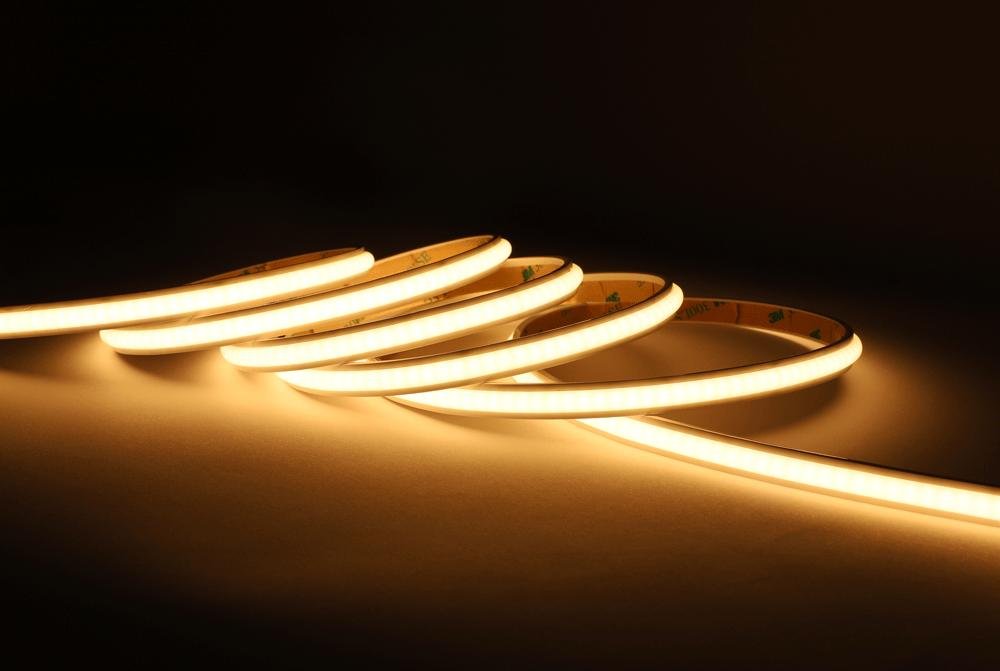
The landscape of architectural lighting has undergone a significant transformation over the last decade. As we move away from purely functional illumination toward lighting that defines the very “feel” of a space, the hardware behind these designs has had to evolve. The most prominent shift has been the move toward seamlessness, the elimination of visible “hotspots” or dots that once characterised early LED installations. Achieving this level of visual continuity requires a deep understanding of both the light source and the electrical infrastructure supporting it.
The Evolution of Seamless Illumination
In the early days of flexible lighting, Surface Mounted Device (SMD) strips were the standard. While effective, they often struggled with “spotting,” where individual diodes were visible through diffusers or reflected on glossy surfaces like marble countertops. Today, the demand for “dotless” lighting has pushed the industry toward Chip-on-Board technology.
This innovation allows for a much higher density of light-emitting diodes to be placed directly onto the flexible PCB. For professionals in the field, sourcing these components from a specialised cob led strip factory is a common strategy to ensure the diode density often exceeding 480 chips per meter is consistent across large-scale projects. This density is what allows for a perfectly uniform line of light, even when the strip is placed in a shallow profile or used without a frosted lens.
Understanding the Mechanics of High-Density Light
The technical advantage of this high-density approach isn’t just aesthetic; it’s also about the beam angle. Traditional LEDs typically offer a 120-degree spread, but modern high-density configurations achieve a 180-degree beam angle. This wider dispersion means light is distributed more evenly from the moment it leaves the phosphor coating, reducing shadows and making the strip ideal for close-proximity lighting in coves, under-cabinets, or recessed wall slots.
However, with higher density comes the challenge of thermal management. When hundreds of tiny diodes are packed into a single meter, they generate concentrated heat. High-quality flexible PCBs (FPC) must be engineered with sufficient copper weight to act as a heat sink. Without proper thermal dissipation, the phosphor can degrade prematurely, leading to a shift in colour temperature or a decrease in overall brightness.
Thermal Dynamics and System Longevity
Longevity in lighting design is rarely about the diodes themselves, which are rated for tens of thousands of hours, but rather about the environment in which they operate. A well-designed system considers the “thermal path”, how heat moves from the chip to the board and finally to the mounting surface (often an aluminium profile).
When these systems are moved outdoors or into high-moisture environments like kitchens, bathrooms, or exterior facades, the complexity increases. It isn’t enough for the light source to be protected; the entire electrical circuit must be shielded from environmental stressors. This is where the reliability of the power conversion becomes the heartbeat of the installation.
Power Stability in Demanding Environments
Electrical components are notoriously sensitive to moisture, dust, and temperature fluctuations. In exterior applications, such as architectural accenting or landscape lighting, the driver is often the most vulnerable point of failure. Using a Waterproof Power Supply with an IP67 rating is a non-negotiable standard for these scenarios. An IP67 rating ensures that the internal components are completely protected against dust ingress and can withstand temporary immersion in water.
These units are typically encased in robust aluminium alloy housings that serve a dual purpose: they provide a physical barrier against the elements and act as a large heat sink for the internal transformer and capacitors. Unlike standard indoor drivers, these units are designed to operate in a wide range of ambient temperatures, ensuring that the light output remains flicker-free even in harsh winter or peak summer conditions.
Circuit Protection and Performance Consistency
Safety in lighting isn’t just about keeping water out; it’s about internal regulation. Modern power architectures incorporate several layers of “invisible” protection. This includes short-circuit protection, which cuts power instantly if a fault is detected, and overload protection, which prevents the unit from drawing more current than its components can handle.
The goal is to maintain a constant voltage, typically 12V or 24V, across the entire run of the light strip. In long runs, “voltage drop” can cause the end of a strip to appear dimmer than the beginning. By pairing high-quality linear light sources with precisely calibrated drivers, designers can ensure that the first inch of light looks identical to the hundredth foot.
Implementation Best Practices
For those overseeing the installation, the “80% Rule” remains a gold standard. This means never loading a power supply to more than 80% of its rated capacity. For example, if a project requires 80 watts of power, a 100-watt driver should be the minimum choice. This headroom allows the unit to run cooler and significantly extends the lifespan of the capacitors.
Furthermore, the integrity of a waterproof system is only as strong as its weakest connection. Using heat-shrink tubing and waterproof connectors at the junction between the strip and the power source is vital. Even the most advanced driver cannot protect the system if moisture “wicks” through the copper wiring into the circuitry.
Conclusion
The success of a modern lighting project lies in the balance between the visible and the invisible. While the high-density light source provides the visual impact, it is the robust electrical foundation that ensures that impact lasts for years. By focusing on the technical synergy between specialised light manufacturing and high-grade environmental protection, professionals can create spaces that are as durable as they are beautiful.
READ MORE: selftimes
